

EGSYS (Evaluation of Guidelines in Syncope Study) is a diagnostic score intended to identify a possible cardiac cause of syncope during initial clinical evaluation. Free, complete, evidence-checked infographic.
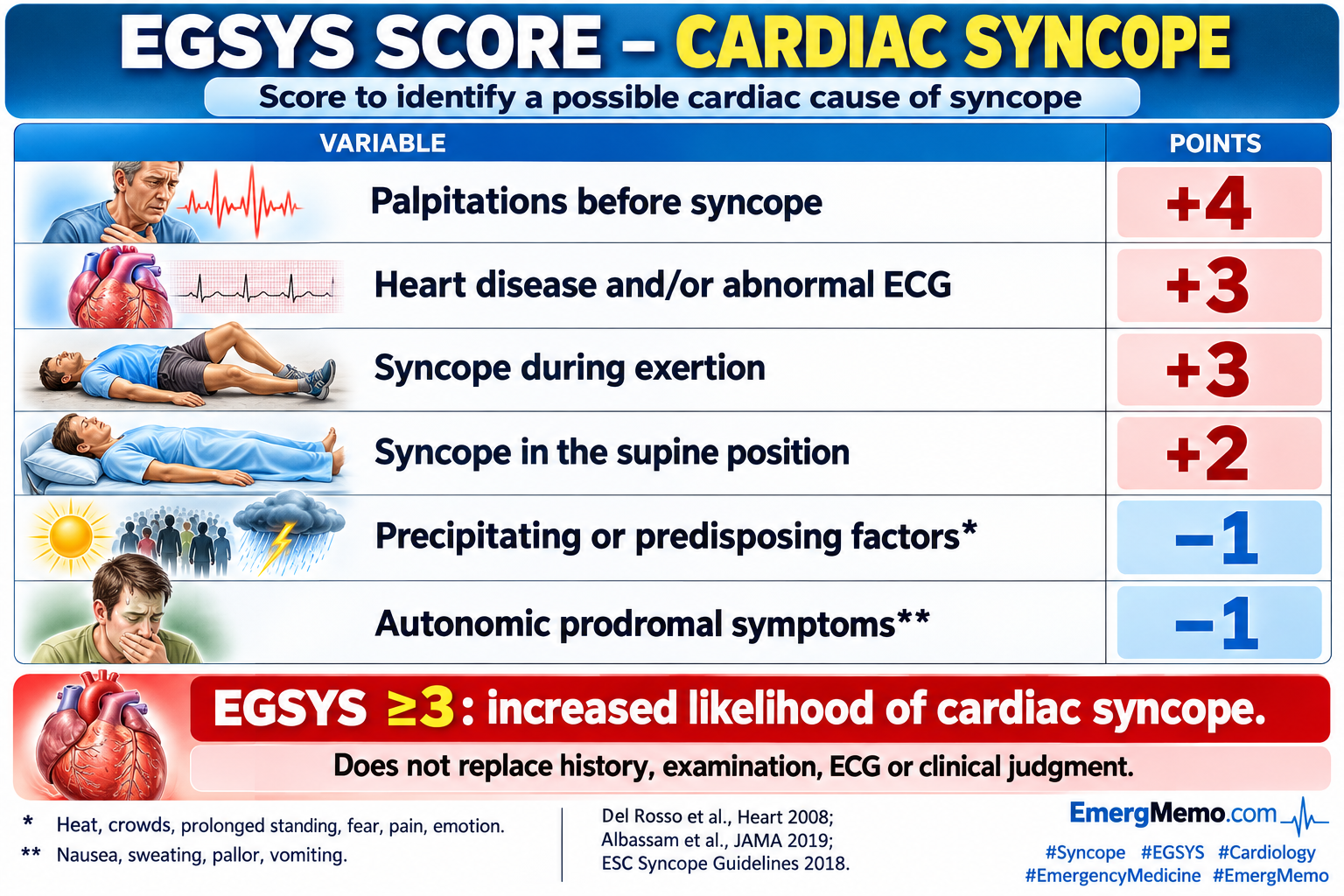
Open the full-resolution English infographic (PNG).
How to calculate the EGSYS Score
- Palpitations before syncope: +4
- Heart disease and/or abnormal ECG: +3
- Syncope during exertion: +3
- Syncope in the supine position: +2
- Precipitating or predisposing factors: −1
- Autonomic prodromal symptoms: −1
Precipitating/predisposing factors: heat, crowded places, prolonged standing, fear, pain or emotional triggers. Autonomic prodromes: nausea, pallor, sweating and/or vomiting. Both of these features carry a negative score, not a positive one.
Clinical interpretation
EGSYS ≥ 3 indicates a higher likelihood of cardiac syncope. In the original study the ≥3 threshold had 95% sensitivity and 61% specificity in the derivation cohort and 92% sensitivity and 69% specificity in the validation cohort. These figures describe diagnostic performance, not an individual patient’s probability of cardiac syncope or death.
Important: EGSYS should not be used alone to decide ED discharge, observation or admission, and it is not a direct short-term mortality-risk score. Combine the score with a complete history, examination, orthostatic blood pressure measurement, 12-lead ECG and assessment for high-risk features. Consider immediate ECG monitoring where high-risk arrhythmic syncope is suspected.
Scientific references
- Del Rosso A. et al. Clinical predictors of cardiac syncope: the EGSYS score. Heart, 2008.
- Albassam O. et al. Did This Patient Have Cardiac Syncope? JAMA, 2019.
- 2018 ESC Guidelines for the diagnosis and management of syncope.
Versione italiana: EGSYS Score — Sincope cardiaca.
#Syncope #EGSYS #Cardiology #EmergencyMedicine #ED #CardiacSyncope #EmergMemo
Educational material for healthcare professionals, created with AI assistance and checked against the sources cited. It does not replace clinical judgment, individual assessment or local protocols.