

Complete English infographic on the Emergency Department Assessment of Chest Pain Score (EDACS) and its accelerated diagnostic protocol (EDACS-ADP), preserving every original score, all three low-risk criteria, non-low-risk triggers and current chest-pain safety considerations.
\n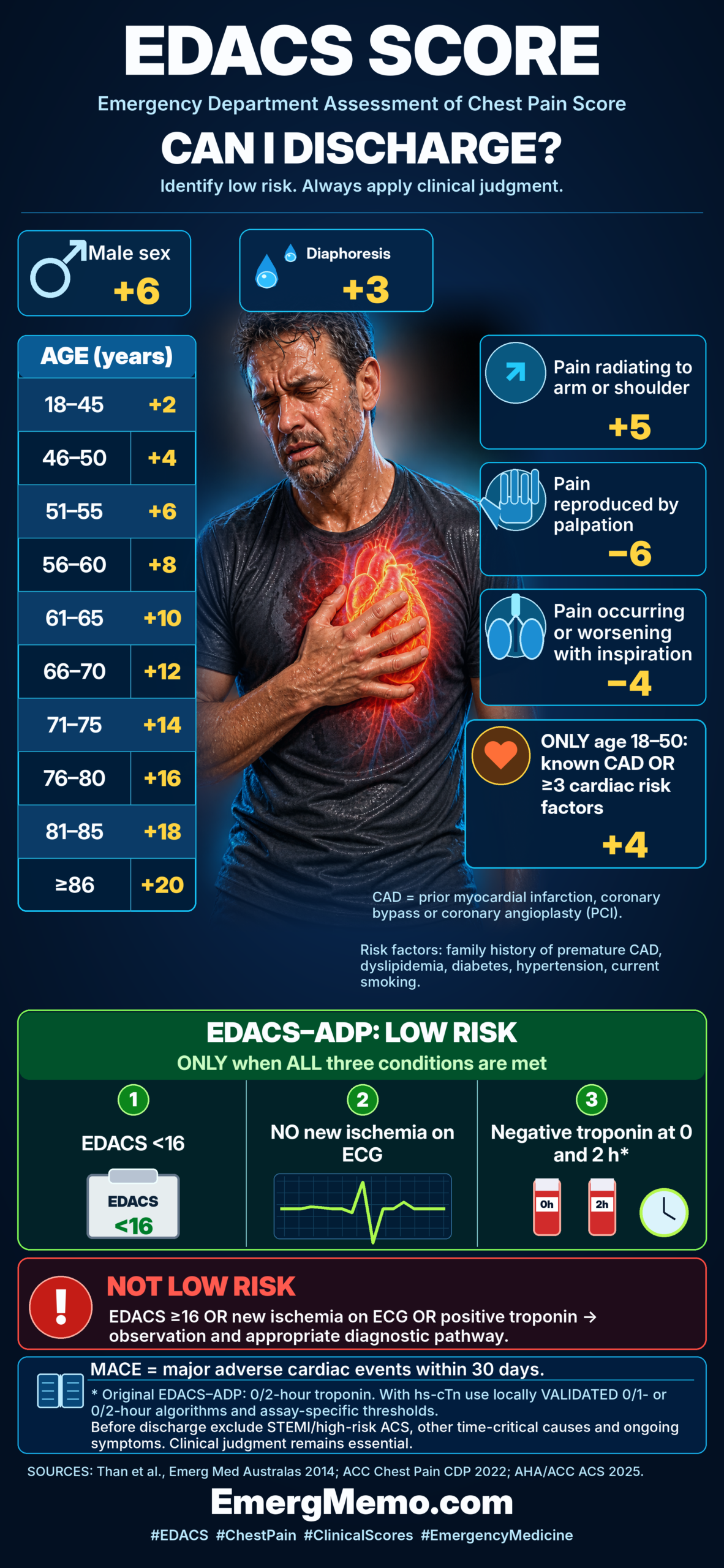
Open the complete high-resolution infographic.
\nVersione italiana: EDACS Score — posso dimetterlo? (infografica italiana completa)
Complete age score (years)
\n- 18–45 +2 points
- 46–50 +4 points
- 51–55 +6 points
- 56–60 +8 points
- 61–65 +10 points
- 66–70 +12 points
- 71–75 +14 points
- 76–80 +16 points
- 81–85 +18 points
- ≥86 +20 points
Clinical factors — original scoring
\n- Male sex: +6 points
- Diaphoresis: +3 points
- Pain radiating to arm or shoulder: +5 points
- Pain beginning or worsening with inspiration: −4 points
- Pain reproduced on palpation: −6 points
- Age 18–50 only: known CAD OR at least three cardiac risk factors: +4 points
Known CAD and risk factor definitions
\nKnown CAD means previous myocardial infarction, coronary artery bypass grafting or percutaneous coronary intervention. Risk factors are a family history of premature CAD, dyslipidemia, diabetes, hypertension and current tobacco smoking. The +4 component applies ONLY to patients aged 18–50, and known CAD plus ≥3 risk factors are a single component, not two additive points.
\nEDACS-ADP — low risk only if ALL conditions are present
\n- EDACS <16
- No new ischemia on the ECG
- Negative cardiac troponin at 0 and 2 hours in the original protocol, interpreted according to the assay and clinical pathway
Not low risk — appropriate assessment
\nAn EDACS ≥16, new ECG ischemia or any positive troponin means the low-risk rule-out criteria are not met; further assessment, monitoring or investigation is required under local pathways. The score alone does not mandate admission or discharge.
\nUpdated clinical safety: troponin timing, ECG and disposition
\nThe original EDACS-ADP combines EDACS with 0- and 2-hour troponins; those criteria must not be indiscriminately applied to all high-sensitivity assays. AHA/ACC 2025 recommends a 12-lead ECG within 10 minutes for suspected ACS, serial ECGs when needed, and preferably high-sensitivity cardiac troponin (hs-cTn). When initial hs-cTn is nondiagnostic, repeat testing is recommended at 1–2 hours (conventional assays at 3–6 hours). Use only a locally validated, assay-specific hs-cTn pathway, accounting for absolute concentrations, change (delta), symptom onset and late presentations. A low EDACS does not independently exclude unstable angina, acute aortic syndrome, pulmonary embolism or other time-sensitive emergencies.
\nMACE and clinical judgment
\nMACE means major adverse cardiac events within 30 days. Early discharge may be considered only after full clinical evaluation, exclusion of high-risk or time-critical conditions, clinical stability and appropriate follow-up. Never use the score alone as an automatic discharge rule.
\nScientific references
\n- Than M et al., 2014 — Development and validation of EDACS / EDACS-ADP
- ACC Expert Consensus Decision Pathway — Acute Chest Pain in the ED (2022)
- AHA/ACC/ACEP et al. — Management of Acute Coronary Syndromes (2025)
Educational material by EmergMemo.com for healthcare professionals, created with AI assistance and medically reviewed against cited sources. It does not replace clinical judgment, applicable guidelines or local protocols. Original 3D artwork with layout faithfully reflecting the supplied source.
\n#EDACS #ChestPain #ClinicalScores #EmergencyMedicine #Cardiology #EmergMemo