Emergency Medicine Updates

Clinical Updates → · Evidence, guidelines, clinical scores, procedures and algorithms.

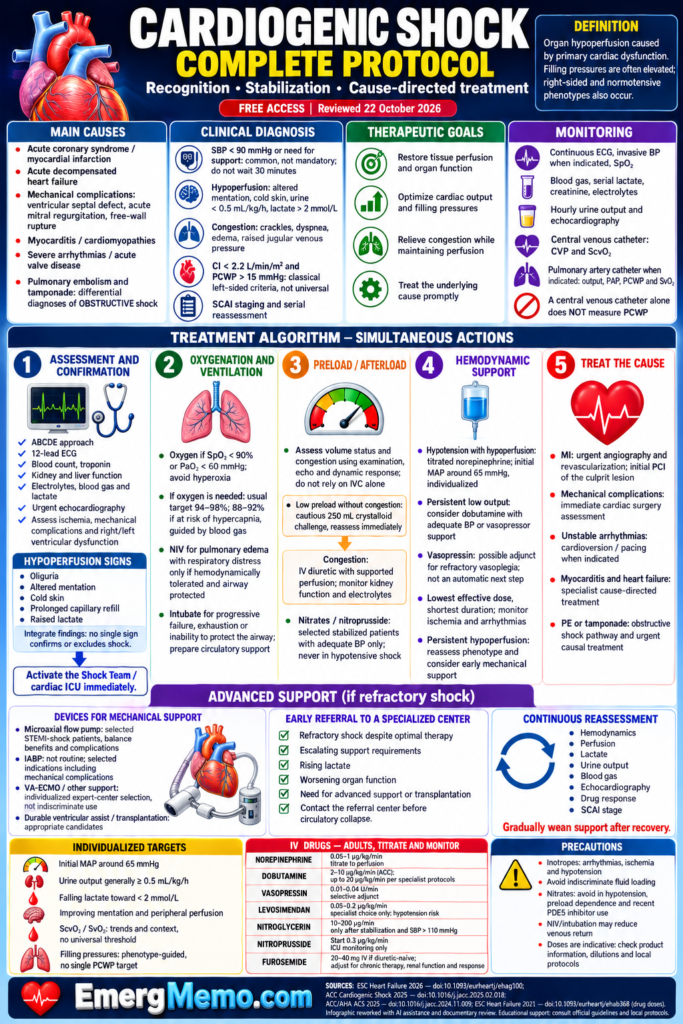
Complete cardiogenic shock protocol: diagnosis, algorithm, monitoring, drug doses, advanced support and precautions. EmergMemo.com, English version.

Cardiogenic shock — Complete protocol | EmergMemo

Complete cardiogenic shock protocol, reworked from the original and reviewed on 22 October 2026. Free access. Includes recognition, treatment algorithm, monitoring, drug doses, advanced support and precautions. Open the image to view and zoom. Complete readable text CARDIOGENIC SHOCK — COMPLETE PROTOCOLRecognition • Stabilization • Cause-directed treatmentFREE ACCESS | Reviewed 22 October 2026 DEFINITION:Organ hypoperfusion

Cardiogenic shock — Complete protocol | EmergMemo Read More »

Sepsis and septic shock — SSC 2026 / NICE NG253

Sepsis and Septic Shock — EmergMemo Emergency Infographic

EmergMemo full-detail English clinical infographic — practical quick reference for emergency clinicians. Open the image for full-size reading. 16/11/2026: A qSOFA below 2 does not exclude sepsis. Use local screening and clinical assessment. Suspected septic shock or probable/definite sepsis: antimicrobials immediately, ideally within 1 hour of recognition. Possible sepsis without shock: assess rapidly; treat within

Sepsis and Septic Shock — EmergMemo Emergency Infographic Read More »

Aortic Dissection — Type A and Type B | Complete Infographic

Complete English infographic — free access. Clinically reviewed: 24 October 2026. Versione italiana. Complete text transcript AORTIC DISSECTION Type A and Type B • Complete clinical guide MECHANISM An intimal tear allows blood to separate the layers of the media, creating a false lumen. Anatomical labels: Intimal tear • Intima • Media • True lumen

Aortic Dissection — Type A and Type B | Complete Infographic Read More »

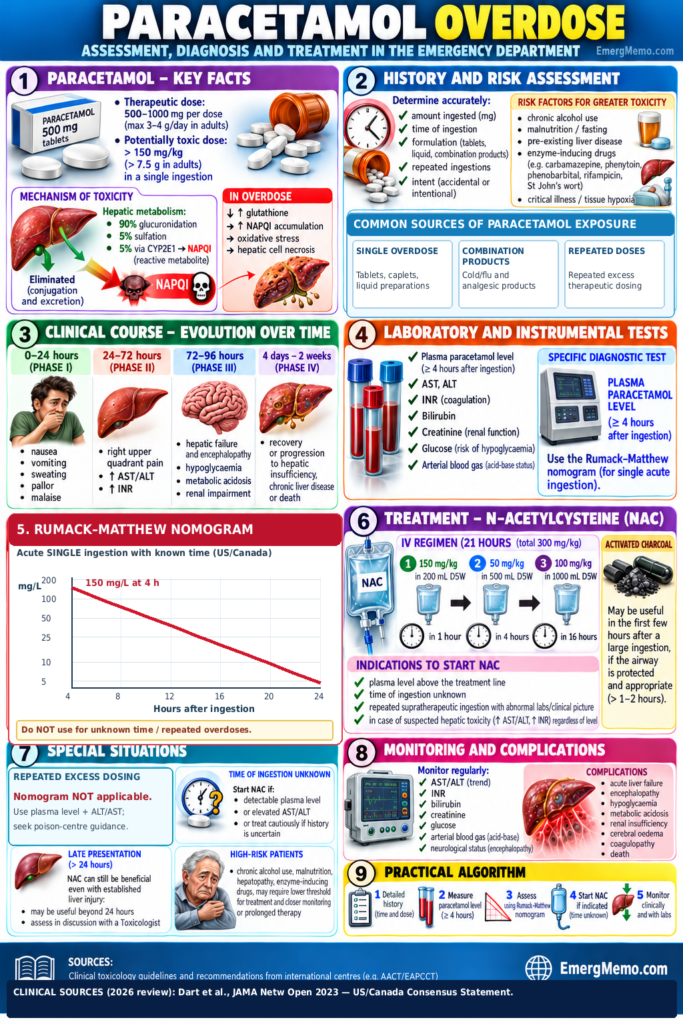
Detailed English clinical infographic: Paracetamol Overdose, EmergMemo.com (2026 review)

Paracetamol Overdose — EmergMemo

EmergMemo full-detail English clinical infographic — practical quick reference for emergency clinicians. Open the image for full-size reading. Clinical overview Acetaminophen (paracetamol) poisoning can cause severe delayed hepatotoxicity. Early risk assessment and timely N-acetylcysteine can prevent liver injury. Important clinical update US/Canada 2023 consensus: for a single acute ingestion with a reliable time, use the

Paracetamol Overdose — EmergMemo Read More »

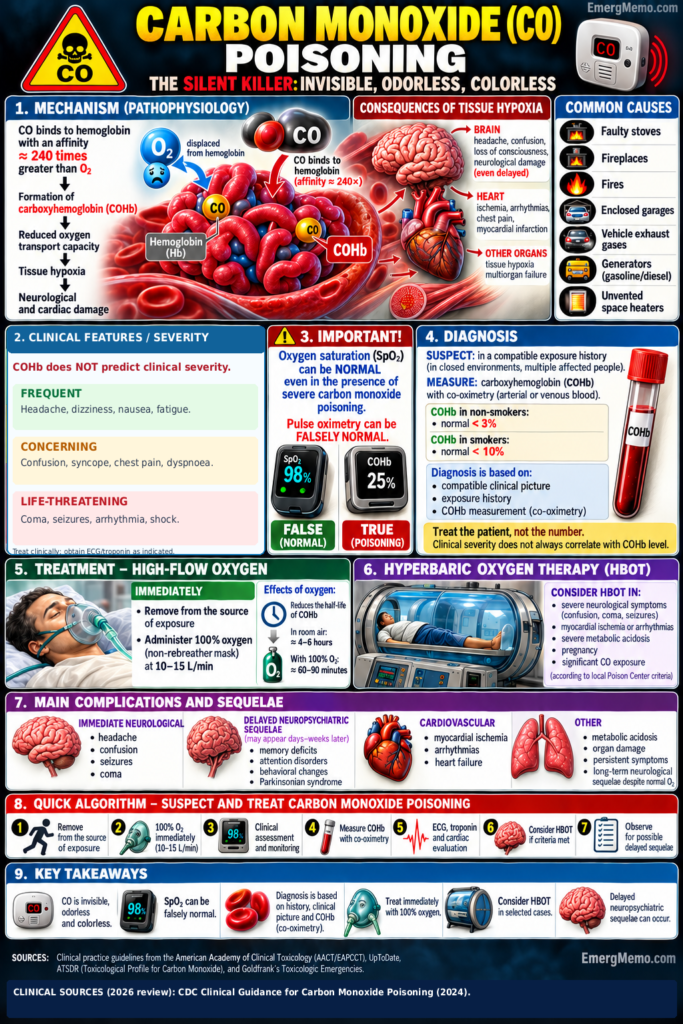
Detailed English clinical infographic: Carbon Monoxide Poisoning, EmergMemo.com (2026 review)

Carbon Monoxide Poisoning — EmergMemo

Versione italiana EmergMemo full-detail English clinical infographic — practical quick reference for emergency clinicians. Open the image for full-size reading. Clinical overview Carbon monoxide exposure may cause neurological and cardiac injury even when the routine pulse oximeter displays a normal oxygen saturation. Important clinical update CDC guidance: COHb levels do not reliably reflect clinical severity

Carbon Monoxide Poisoning — EmergMemo Read More »

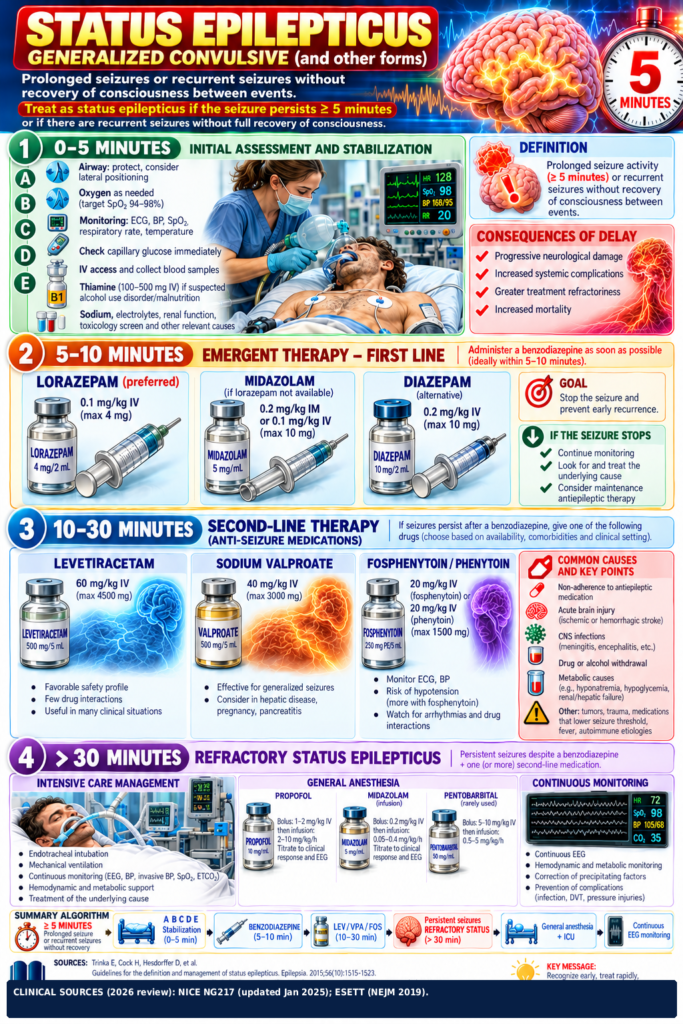
Detailed English clinical infographic: Convulsive Status Epilepticus, EmergMemo.com (2026 review)

Convulsive Status Epilepticus — EmergMemo

EmergMemo full-detail English clinical infographic — practical quick reference for emergency clinicians. Open the image for full-size reading. Clinical overview Treat ongoing convulsive seizures lasting 5 minutes or more, or recurrent seizures without recovery, as status epilepticus. Important clinical update Stabilise the airway and circulation, check bedside glucose, administer an appropriately dosed benzodiazepine promptly, then

Convulsive Status Epilepticus — EmergMemo Read More »

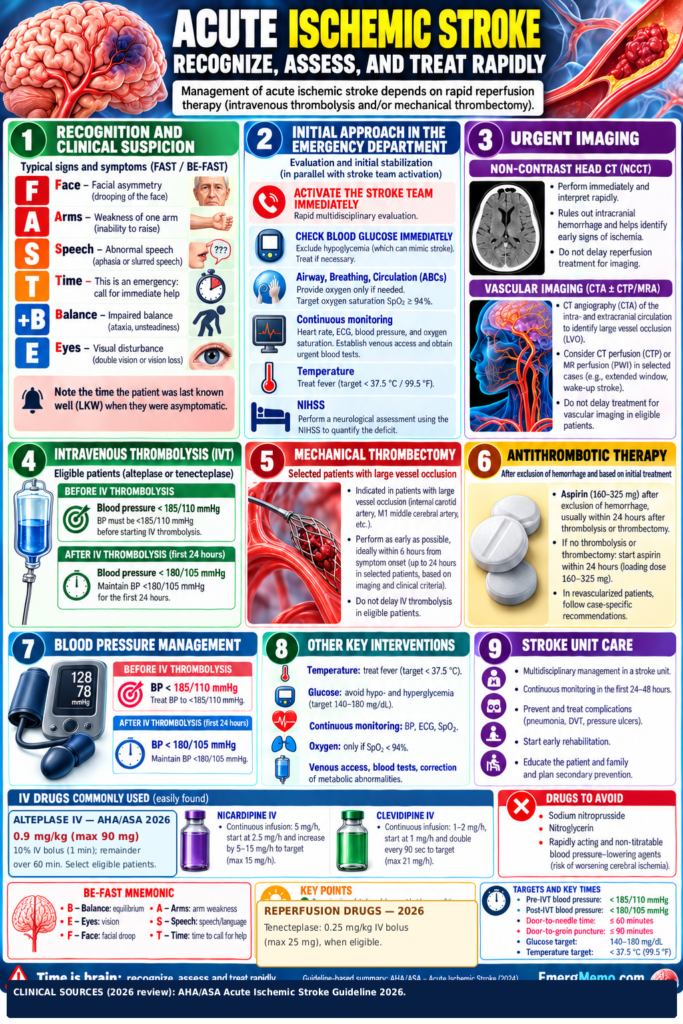
Detailed English clinical infographic: Acute Ischaemic Stroke, EmergMemo.com (2026 review)

Acute Ischaemic Stroke — EmergMemo

EmergMemo full-detail English clinical infographic — practical quick reference for emergency clinicians. Open the image for full-size reading. Clinical correction — 26 October 2026: the infographic has been replaced with a corrected version. After IV thrombolysis, obtain follow-up CT/MRI at 24 hours and exclude haemorrhage before starting antiplatelet or anticoagulant therapy. Earlier treatment is reserved

Acute Ischaemic Stroke — EmergMemo Read More »

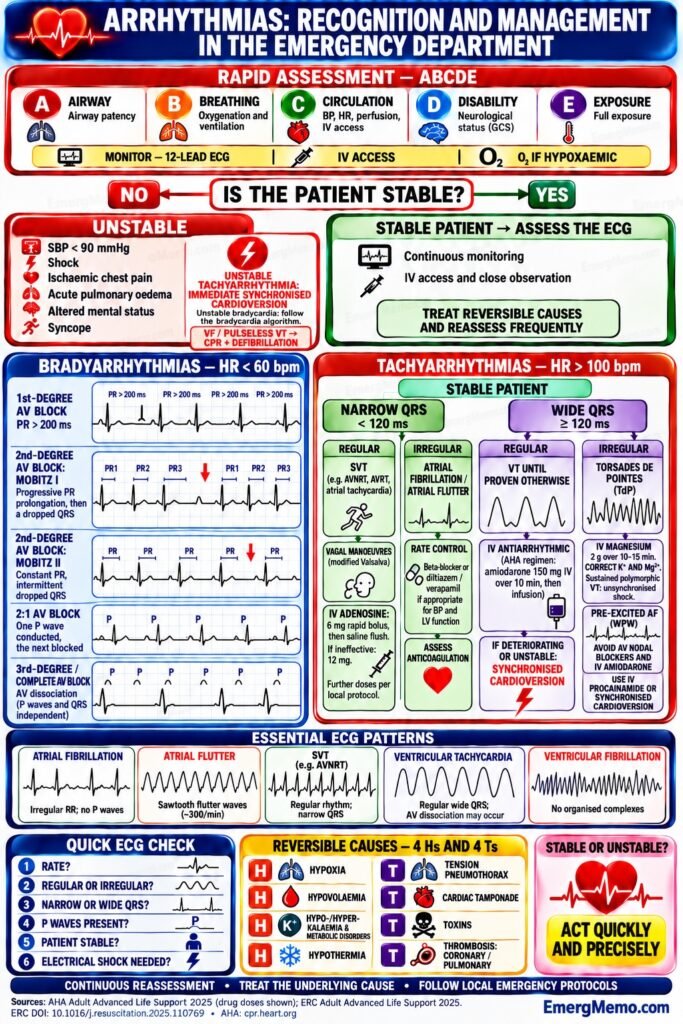
English EmergMemo infographic on emergency assessment of arrhythmias, AV blocks and tachyarrhythmias. Read the accompanying clinical notes.

Arrhythmias: Recognition and Management in the Emergency Department

An at-a-glance visual overview for emergency physicians, paramedics and nurses: ABCDE assessment, haemodynamic stability, AV blocks and tachyarrhythmias. Open the image for full-resolution reading. Read alongside the infographic: sustained polymorphic VT requires immediate unsynchronised defibrillation, even with a pulse; do not delay shock for magnesium. Torsades de pointes is polymorphic VT associated with QT prolongation,

Arrhythmias: Recognition and Management in the Emergency Department Read More »