
Complete English infographic — free access. Clinically reviewed: 24 October 2026. Versione italiana.
Complete text transcript
AORTIC DISSECTION
Type A and Type B • Complete clinical guide
MECHANISM
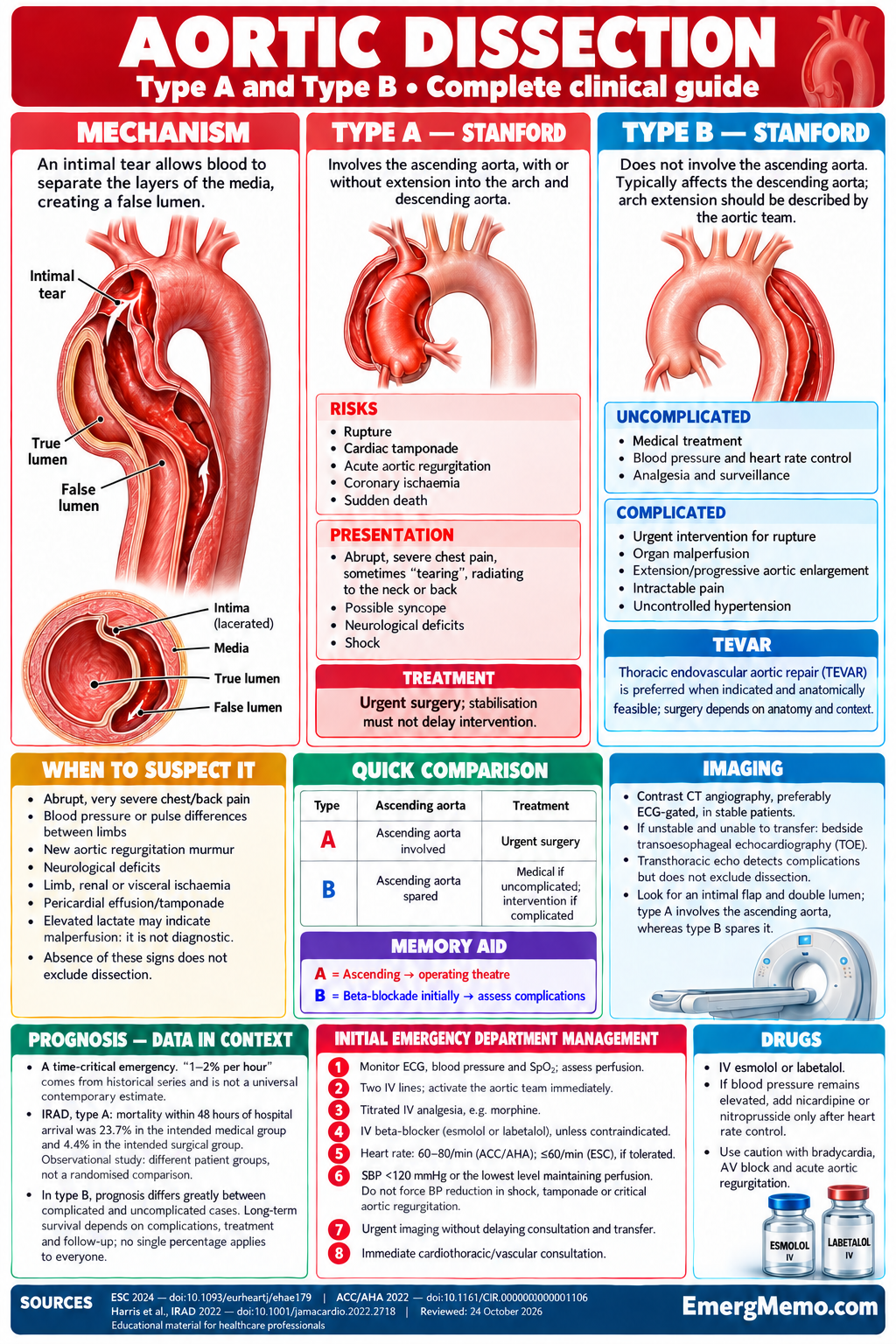
An intimal tear allows blood to separate the layers of the media, creating a false lumen.
Anatomical labels: Intimal tear • Intima • Media • True lumen • False lumen.
TYPE A — STANFORD
Involves the ascending aorta, with or without extension into the arch and descending aorta.
Risks: rupture, cardiac tamponade, acute aortic regurgitation, coronary ischaemia, sudden death.
Presentation: abrupt, severe chest pain, sometimes “tearing”, radiating to the neck or back; possible syncope, neurological deficits and shock.
TREATMENT: urgent surgery; stabilisation must not delay intervention.
TYPE B — STANFORD
Does not involve the ascending aorta. Typically affects the descending aorta; arch extension should be described by the aortic team.
Uncomplicated: medical treatment, blood pressure and heart rate control, analgesia and surveillance.
Complicated: urgent intervention for rupture, organ malperfusion, extension/progressive aortic enlargement, intractable pain or uncontrolled hypertension.
TEVAR (thoracic endovascular aortic repair) is preferred when indicated and anatomically feasible; surgery depends on anatomy and context.
QUICK COMPARISON
A | Ascending aorta involved | Urgent surgery
B | Ascending aorta spared | Medical if uncomplicated; intervention if complicated
MEMORY AID
A = Ascending → operating theatre
B = Beta-blockade initially → assess complications
WHEN TO SUSPECT IT
Abrupt, very severe chest/back pain; blood pressure or pulse differences between limbs; new aortic regurgitation murmur; neurological deficits; limb, renal or visceral ischaemia; pericardial effusion/tamponade. Elevated lactate may indicate malperfusion: it is not diagnostic. Absence of these signs does not exclude dissection.
IMAGING
Contrast CT angiography, preferably ECG-gated, in stable patients. If unstable and unable to transfer: bedside transoesophageal echocardiography (TOE). Transthoracic echo detects complications but does not exclude dissection.
Look for an intimal flap and double lumen; type A involves the ascending aorta, whereas type B spares it.
PROGNOSIS — DATA IN CONTEXT
A time-critical emergency. “1–2% per hour” comes from historical series and is not a universal contemporary estimate.
IRAD, type A: mortality within 48 hours of hospital arrival was 23.7% in the intended medical group and 4.4% in the intended surgical group. Observational study: different patient groups, not a randomised comparison.
In type B, prognosis differs greatly between complicated and uncomplicated cases. Long-term survival depends on complications, treatment and follow-up; no single percentage applies to everyone.
INITIAL EMERGENCY DEPARTMENT MANAGEMENT
1. Monitor ECG, blood pressure and SpO₂; assess perfusion.
2. Two IV lines; activate the aortic team immediately.
3. Titrated IV analgesia, e.g. morphine.
4. IV beta-blocker (esmolol or labetalol), unless contraindicated.
5. Heart rate: 60–80/min (ACC/AHA); ≤60/min (ESC), if tolerated.
6. SBP <120 mmHg or the lowest level maintaining perfusion. Do not force BP reduction in shock, tamponade or critical aortic regurgitation.
7. Urgent imaging without delaying consultation and transfer.
8. Immediate cardiothoracic/vascular consultation.
DRUGS
IV esmolol or labetalol. If blood pressure remains elevated, add nicardipine or nitroprusside only after heart rate control. Use caution with bradycardia, AV block and acute aortic regurgitation.
SOURCES
ESC 2024 — doi:10.1093/eurheartj/ehae179
ACC/AHA 2022 — doi:10.1161/CIR.0000000000001106
Harris et al., IRAD 2022 — doi:10.1001/jamacardio.2022.2718
Reviewed: 24 October 2026 • Educational material for healthcare professionals
EmergMemo.com