

Glomerular filtration rate (eGFR): an educational infographic covering kidney filtration, estimation and measurement methods, KDIGO G1–G5 and A1–A3 categories, prognostic risk, and comparison with serum creatinine and blood urea nitrogen (BUN). A practical resource for emergency and acute care clinicians.
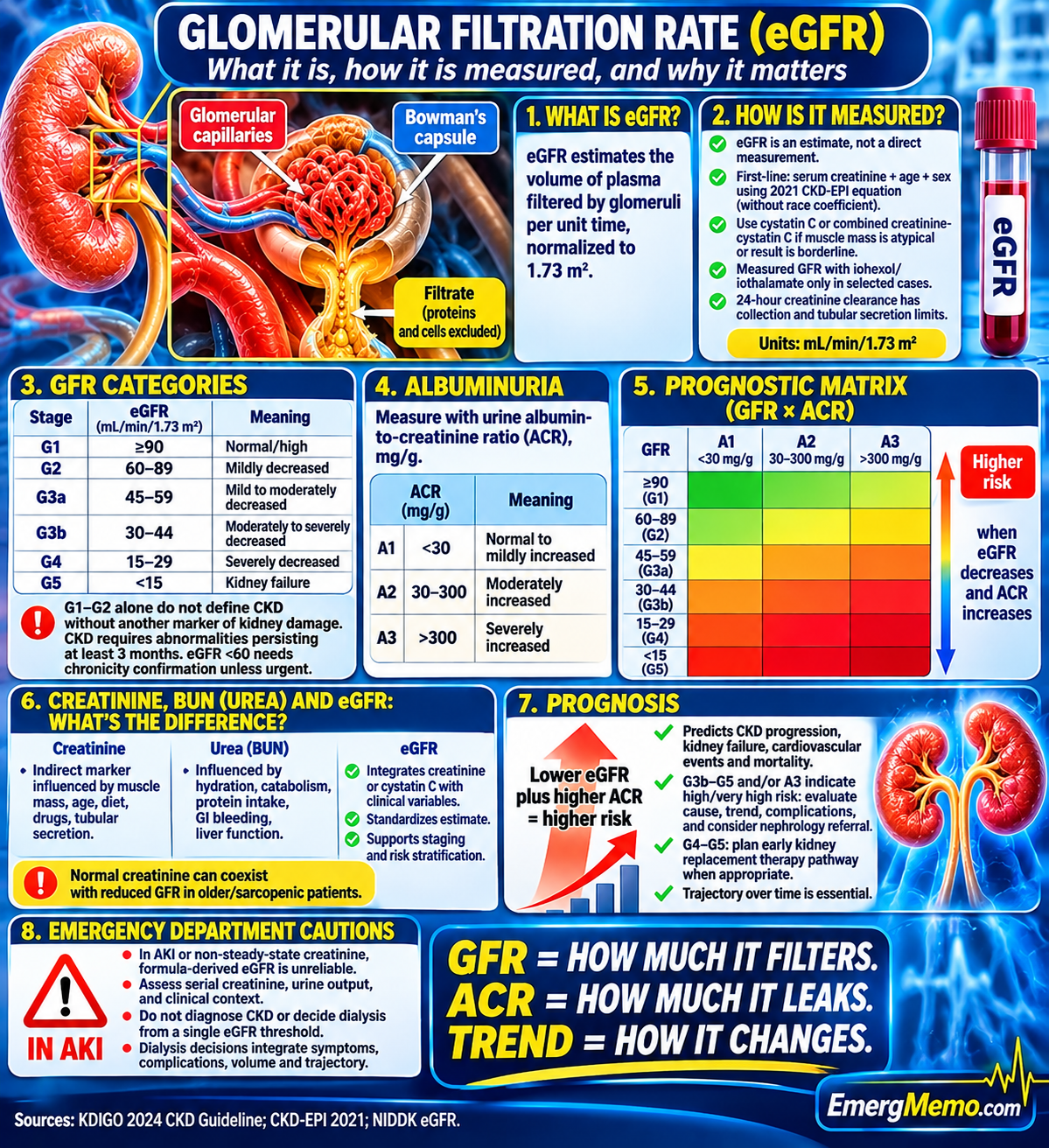
Open or download the full-resolution infographic.
How to interpret eGFR
Estimated glomerular filtration rate (eGFR) estimates the volume of plasma filtered by the glomeruli per unit time, indexed to a body surface area of 1.73 m². In routine practice it is usually calculated from serum creatinine using the 2021 CKD-EPI equation. Cystatin C or the combined creatinine–cystatin C equation can improve estimation in selected patients, especially when muscle mass is atypical or the creatinine-based estimate is borderline. Twenty-four-hour creatinine clearance is limited by collection errors and tubular secretion; exogenous-marker measured GFR is reserved for selected indications.
- G1: ≥90; G2: 60–89; G3a: 45–59; G3b: 30–44; G4: 15–29; G5: <15 mL/min/1.73 m².
- Albuminuria (urine ACR): A1 <30; A2 30–300; A3 >300 mg/g.
- G1–G2 alone do not establish chronic kidney disease (CKD): markers of kidney damage and persistence for at least 3 months are required. An eGFR <60 should be interpreted in context and chronicity confirmed when clinically appropriate.
Prognostic value and emergency-care limitations
Combining eGFR with urine albumin-to-creatinine ratio (ACR) stratifies the risk of CKD progression, kidney failure, cardiovascular events and mortality. Risk generally rises as eGFR falls and albuminuria increases; the trajectory over time is essential. Serum creatinine may be falsely reassuring in older or sarcopenic patients, while BUN is also influenced by hydration, catabolism, dietary protein, gastrointestinal bleeding and liver function.
Emergency department caution: in acute kidney injury (AKI), or whenever serum creatinine is not at steady state, formula-derived eGFR is unreliable. Integrate serial creatinine, urine output, volume status, electrolytes and the clinical picture. Do not diagnose CKD or make dialysis decisions from one isolated value.
Sources: KDIGO 2024 Clinical Practice Guideline for the Evaluation and Management of CKD; CKD-EPI 2021; NIDDK eGFR. AI-assisted educational resource; it does not replace clinical assessment, guidelines or local protocols.