
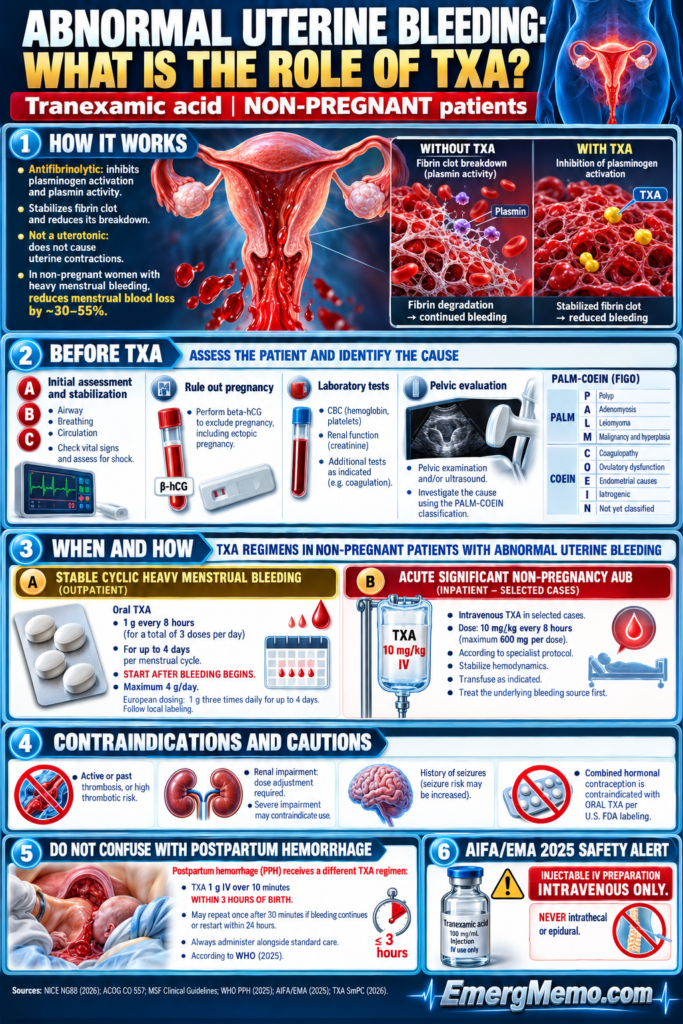
Complete clinical infographic • Free access • Adults with abnormal uterine bleeding unrelated to pregnancy. Tranexamic acid (TXA) can reduce blood loss, but it does not treat the underlying cause and must not replace resuscitation in severe bleeding.
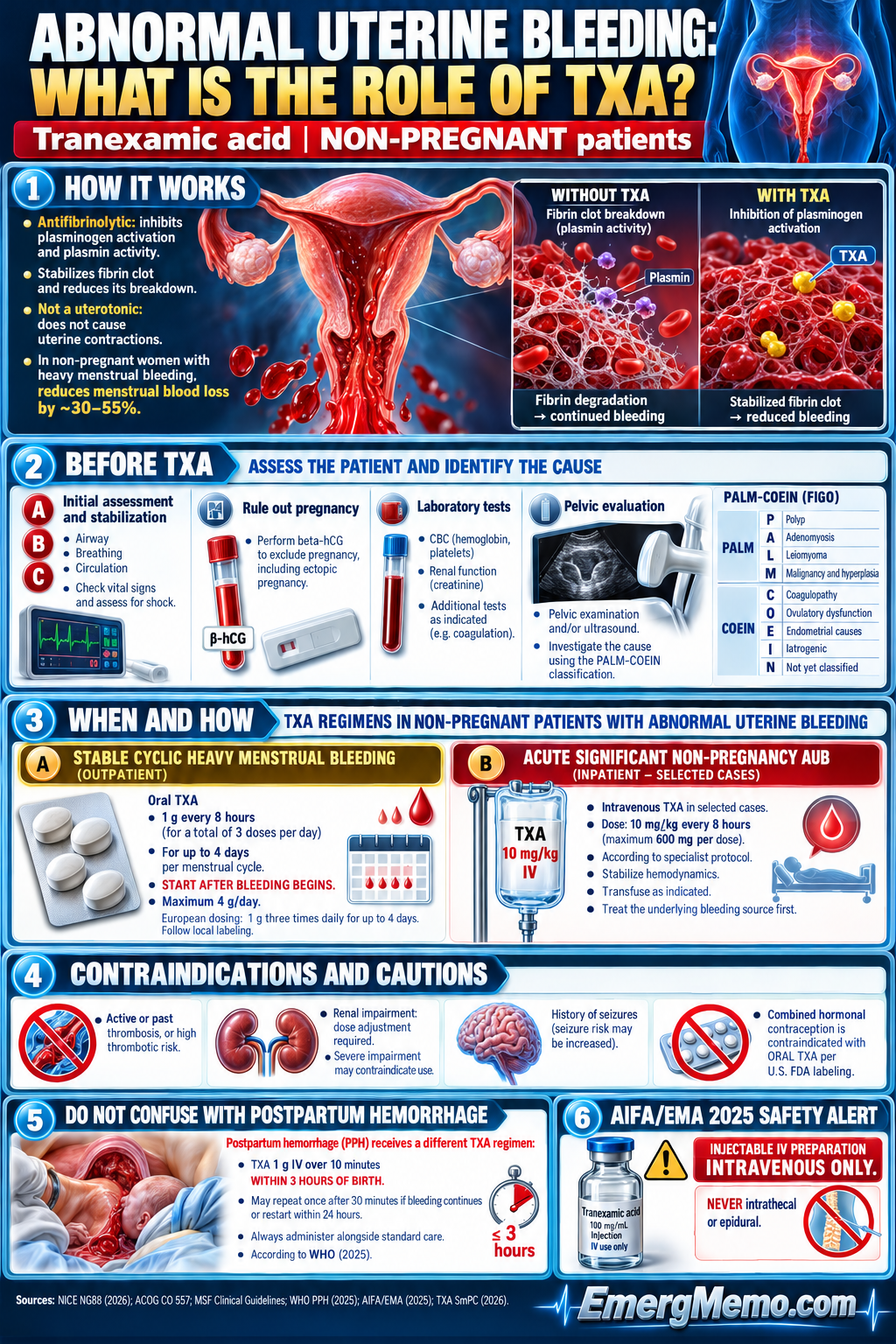
1. Mechanism and efficacy
TXA is an antifibrinolytic: it inhibits plasminogen activation and fibrin breakdown, stabilizing the clot. It is not a uterotonic and does not stimulate myometrial contraction. In cyclic heavy menstrual bleeding, it reduces blood loss by approximately 30–55%; evidence for acute nonpregnant bleeding is less robust.
2. Before treatment: assess severity and establish the cause
- ABCDE, vital signs, amount of blood loss, perfusion and signs of shock; establish IV access and prepare blood products when indicated.
- Perform β-hCG testing whenever pregnancy is possible: pregnancy-related bleeding, including ectopic pregnancy, requires a different diagnostic pathway.
- CBC (hemoglobin/platelets), renal function and, as clinically indicated, coagulation tests, blood group/crossmatch and iron-deficiency assessment.
- Gynecologic assessment, targeted ultrasound and investigation of structural/nonstructural causes using PALM–COEIN; consider endometrial sampling based on age and risk factors.
3. Stable cyclic heavy menstrual bleeding
- Reference European oral regimen: 1 g orally every 8 hours, starting after menstrual bleeding begins, for up to 4 days per cycle; do not exceed 4 g/day. Verify the local product SmPC.
- TXA reduces blood loss but is neither contraception nor treatment of the underlying cause. Consider other options (LNG-IUS, hormonal therapy, procedures) according to indication and patient preference.
- Licensed regimens vary by country: the US Lysteda label recommends 1.3 g orally three times daily for up to 5 days. Do not interchange national dosing schedules without checking product labeling.
4. Major acute abnormal uterine bleeding unrelated to pregnancy
- Hemodynamic stabilization, urgent gynecologic assessment, blood products and treatment of the underlying cause remain priorities.
- For selected inpatients, the MSF protocol describes IV TXA 10 mg/kg every 8 hours, maximum 600 mg per dose, followed by oral TXA once bleeding decreases. This is a protocol-specific regimen, not a universal dose for every bleeding patient.
- The evidence base for acute AUB is more limited than that for cyclic heavy menstrual bleeding. Follow clinical assessment, local protocols and specialist advice; refractory cases may require hormonal therapies, tamponade or procedural/surgical control.
5. Contraindications, interactions and precautions
- Do not use in active or previous thrombosis, severe renal impairment or a history of seizures where contraindicated by the applicable SmPC; also assess allergy and prothrombotic conditions.
- Mild-to-moderate renal impairment requires dose adjustment according to product labeling and kidney function.
- Combined hormonal contraception: co-use with oral TXA is contraindicated in the US FDA label; European SmPCs require at least careful thrombotic-risk assessment. Check the local product information.
- Promptly reassess suspected thromboembolism, visual disturbances or seizures.
6. Do not confuse with postpartum hemorrhage
Postpartum hemorrhage follows a separate regimen: according to WHO 2025, give 1 g IV TXA over 10 minutes within 3 hours of birth, in addition to standard care. A second 1 g IV dose can be given if bleeding continues after 30 minutes or restarts within 24 hours.
7. AIFA/EMA route-of-administration safety warning (2025)
Injectable TXA formulations are for intravenous use only. Intrathecal, epidural, intraventricular or intracerebral administration is contraindicated. Keep TXA separate from local anesthetics and clearly label IV syringes: vial mix-ups have caused serious and fatal adverse events.
Scientific references
- NICE NG88, Heavy menstrual bleeding (ultimo aggiornamento 2026)
- ACOG Committee Opinion 557, Acute AUB (2013)
- MSF, Abnormal uterine bleeding in the absence of pregnancy
- Tranexamic acid 500 mg, SmPC (2026)
- WHO, Consolidated postpartum haemorrhage recommendations (2025)
- AIFA, avviso di sicurezza TXA endovenoso (11 dicembre 2025)
- FDA Lysteda, prescribing information (2020)
Educational material for healthcare professionals, prepared with AI assistance and reviewed against the references cited. Prescribing requires assessment of severity, licensed indication, kidney function, contraindications and local protocols. Reviewed: 28 October 2026. © EmergMemo.com.
Versione italiana: Sanguinamento uterino anomalo: quale ruolo per il TXA? (Italian complete article).