
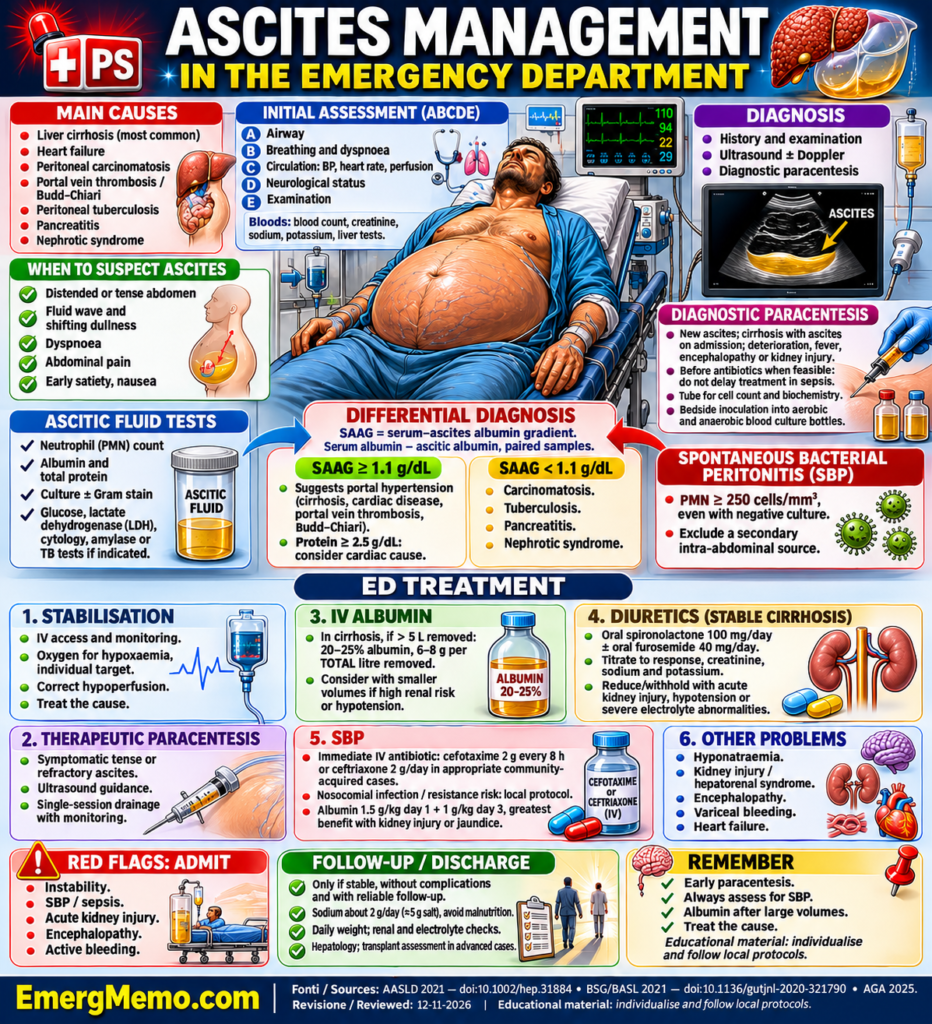
Ascites in the Emergency Department: causes, initial assessment, differential diagnosis, paracentesis, spontaneous bacterial peritonitis and treatment.
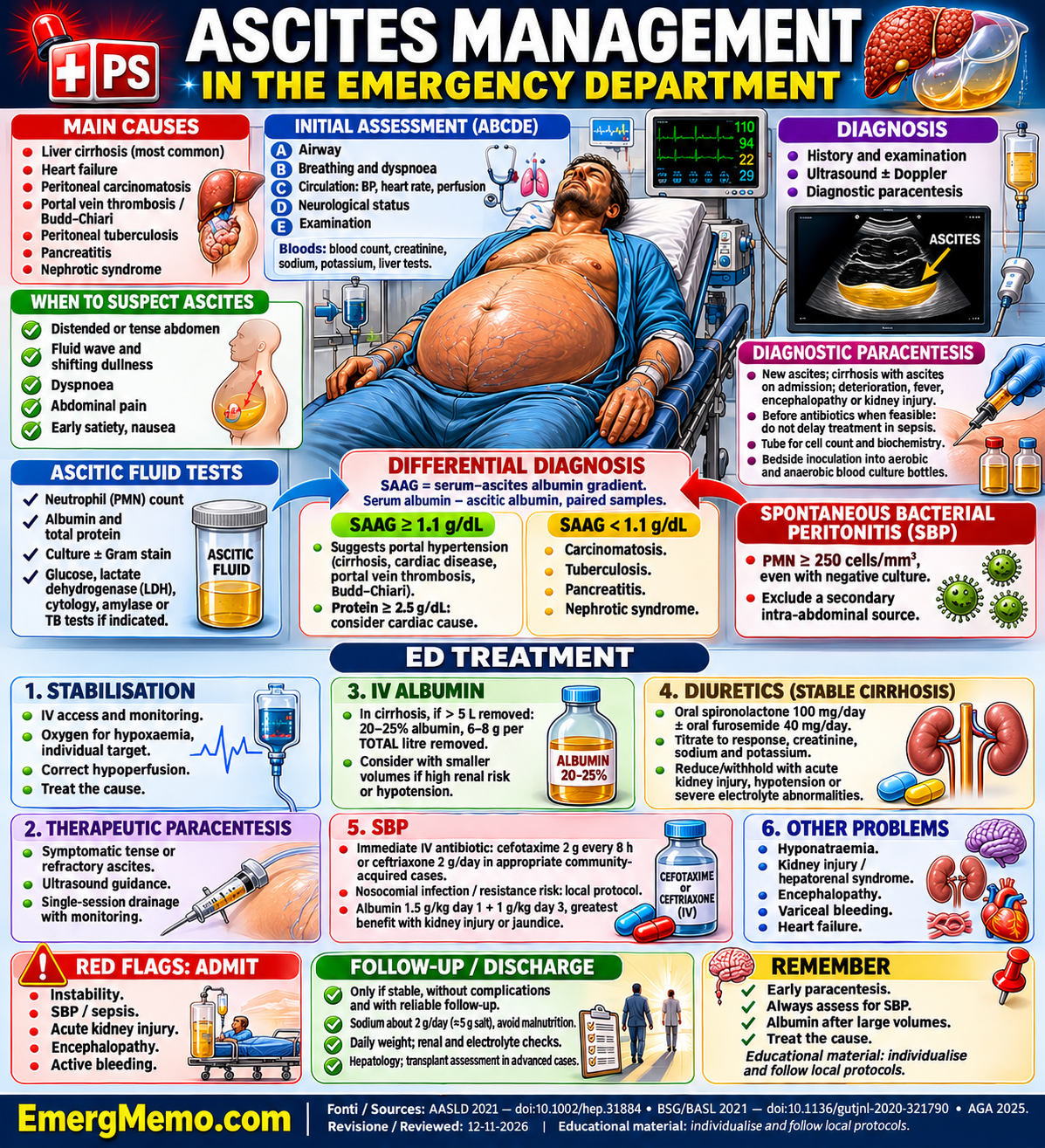
Open the full infographic and zoom
Clinical notes
SAAG guides assessment for portal hypertension and requires interpretation alongside clinical findings and ascitic protein. Spontaneous bacterial peritonitis also requires exclusion of a secondary intra-abdominal source.
Diuretic doses shown are usual adult starting doses in stable cirrhosis, requiring adjustment for kidney function, electrolytes and existing treatment. Listed antibiotics are options for appropriate community-acquired cases; allergies, kidney function, nosocomial infection and resistance risk affect selection.
Fluid restriction is not routine for ascites; assess its role in hyponatraemia according to severity and volume status. After paracentesis of >5 L, calculate albumin replacement using the entire volume removed.
References
Biggins et al. AASLD Practice Guidance. Hepatology, 2021. doi:10.1002/hep.31884.
Reviewed: 12 November 2026. Educational content for healthcare professionals, created with AI assistance and checked against the cited references. Individualise management and follow local protocols.