
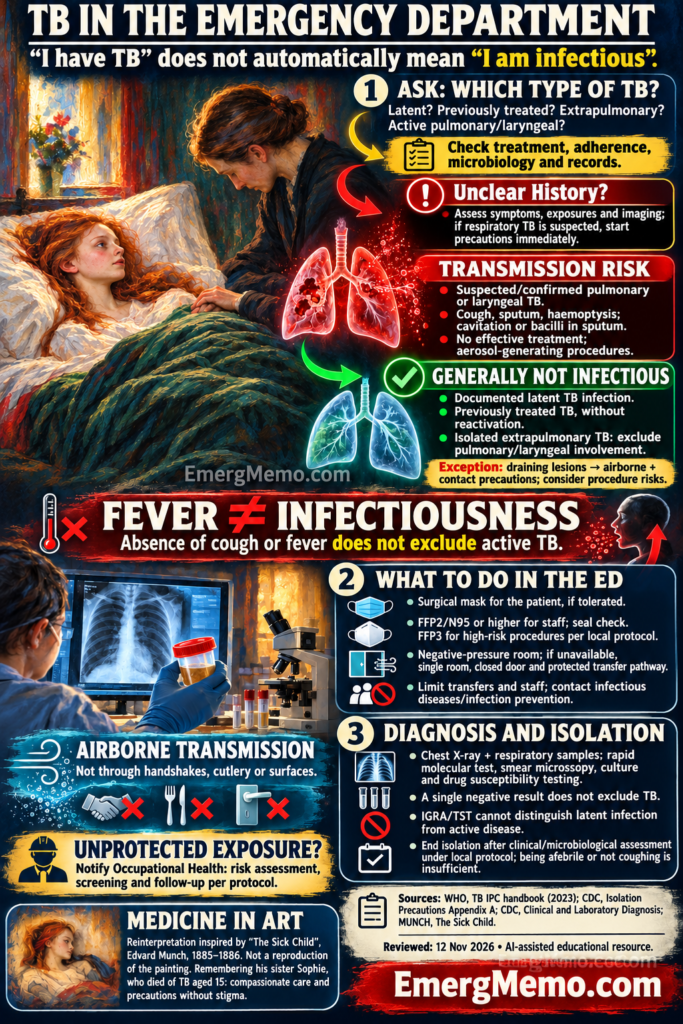

TB IN THE EMERGENCY DEPARTMENT
“I have TB” does not automatically mean “I am infectious”.
1 • ASK: WHICH TYPE OF TB?
Latent? Previously treated? Extrapulmonary? Active pulmonary/laryngeal?
Check treatment, adherence, microbiology and records.
Unclear history? Assess symptoms, exposures and imaging; if respiratory TB is suspected, start precautions immediately.
TRANSMISSION RISK
• Suspected/confirmed pulmonary or laryngeal TB.
• Cough, sputum, haemoptysis; cavitation or bacilli in sputum.
• No effective treatment; aerosol-generating procedures.
GENERALLY NOT INFECTIOUS
• Documented latent TB infection.
• Previously treated TB, without reactivation.
• Isolated extrapulmonary TB: exclude pulmonary/laryngeal involvement.
Exception: draining lesions → airborne + contact precautions; consider procedure risks.
FEVER ≠ INFECTIOUSNESS
Absence of cough or fever does not exclude active TB.
2 • WHAT TO DO IN THE ED
• Surgical mask for the patient, if tolerated.
• FFP2/N95 or higher for staff; seal check. FFP3 for high-risk procedures per local protocol.
• Negative-pressure room; if unavailable, single room, closed door and protected transfer pathway.
• Limit transfers and staff; contact infectious diseases/infection prevention.
3 • DIAGNOSIS AND ISOLATION
Chest X-ray + respiratory samples: rapid molecular test, smear microscopy, culture and drug susceptibility testing.
A single negative result does not exclude TB.
IGRA/TST cannot distinguish latent infection from active disease.
End isolation after clinical/microbiological assessment under local protocol; being afebrile or not coughing is insufficient.
AIRBORNE TRANSMISSION
Not through handshakes, cutlery or surfaces.
UNPROTECTED EXPOSURE?
Notify Occupational Health: risk assessment, screening and follow-up per protocol.
MEDICINE IN ART
Reinterpretation inspired by “The Sick Child”, Edvard Munch, 1885–1886. Not a reproduction of the painting. Remembering his sister Sophie, who died of TB aged 15: compassionate care and precautions without stigma.
Sources: WHO, TB IPC handbook (2023); CDC, Isolation Precautions Appendix A; CDC, Clinical and Laboratory Diagnosis; MUNCH, The Sick Child.
Reviewed: 12 Nov 2026 • AI-assisted educational resource.
EmergMemo.com
WHO • TB infection prevention and control, 2023
CDC • Isolation Precautions, Appendix A
CDC • Clinical and Laboratory Diagnosis
ATS/CDC/IDSA • Diagnosis of TB