
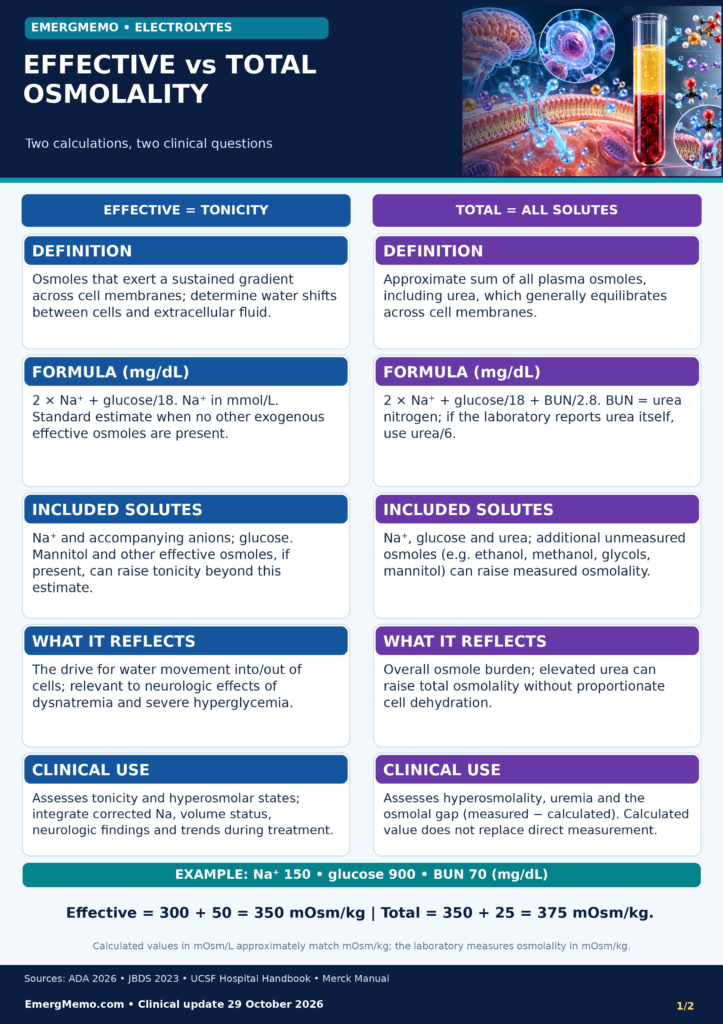
Two complete, freely accessible English 3D clinical infographics comparing tonicity and total osmolality, with formulas, BUN–urea conversion, osmolal gap, hyperosmolar hyperglycemic state and pitfalls.
Two full-resolution, freely accessible figures with original 3D medical illustration, sources and EmergMemo.com watermark.
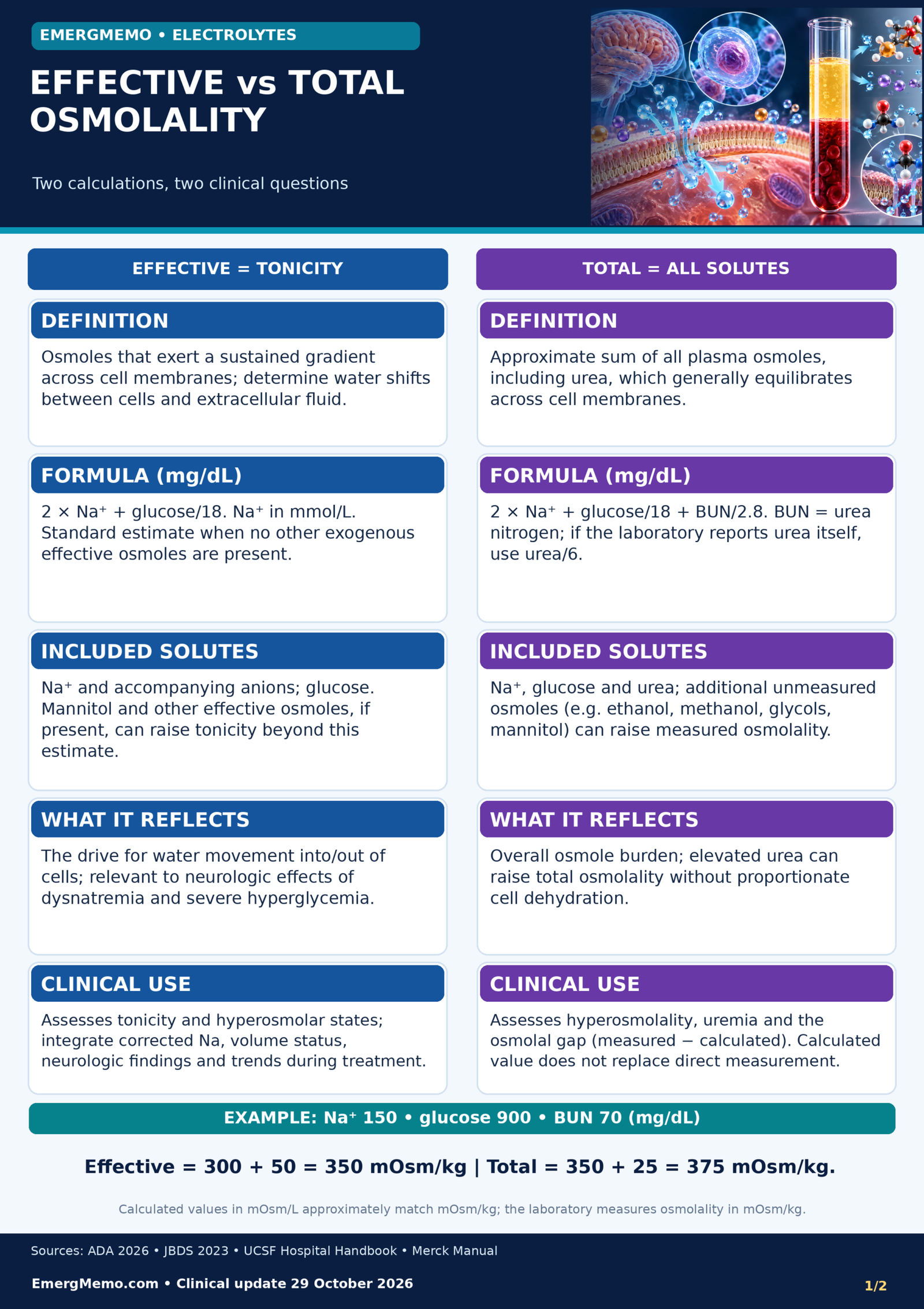

Versione italiana: Osmolarità efficace e totale
Definitions: tonicity vs total osmolality
Osmolality denotes the number of osmoles per kilogram of solvent (mOsm/kg), while osmolarity uses osmoles per liter of solution (mOsm/L). Values are numerically close in plasma but are not strictly identical. Tonicity (effective osmolality) reflects osmotic forces from solutes that do not readily cross cell membranes. Urea generally equilibrates across membranes and contributes substantially to measured total osmolality, yet less to sustained tonicity than sodium or glucose. Thus high urea alone does not imply the same cellular dehydration as high sodium or glucose.
Conventional-unit formulas: distinguish BUN from urea
For Na⁺ in mmol/L and glucose in mg/dL: effective osmolality ≈ 2 × Na⁺ + glucose/18. Calculated total osmolality ≈ 2 × Na⁺ + glucose/18 + BUN/2.8, but ONLY when the reported parameter is blood urea nitrogen (BUN) in mg/dL. When the laboratory reports urea concentration itself in mg/dL, use urea/6 instead. With analytes in mmol/L, total osmolality ≈ 2 × Na⁺ + glucose + urea; omit urea for effective osmolality. Extra osmoles such as mannitol are not accounted for by the usual simple formula.
Corrected source example: Na 150, glucose 900, BUN 70
Effective osmolality ≈ 2×150 + 900/18 = 300 + 50 = 350. Total osmolality ≈ 350 + 70/2.8 = 375. BUN 70 mg/dL corresponds to approximately 150 mg/dL of urea; urea/6 therefore gives the same 25 mOsm contribution. The label «uremia/azotemia 70» is not specific enough to calculate osmolality correctly without verifying which laboratory analyte was measured. Interpret numbers alongside hemodynamic, renal and neurologic findings.
Measured osmolality and the osmolal gap
Directly measured osmolality may differ from the calculated estimate. Osmolal gap = measured − calculated osmolality; a notable gap (for instance >10 mOsm/kg, depending on assay and formula) suggests additional osmoles: ethanol, methanol, ethylene glycol, isopropanol, mannitol or others. When ethanol is known, UCSF includes EtOH (mg/dL)/4.6 in the estimate. A normal osmolal gap does not rule out toxic alcohol ingestion; evaluate the anion gap, acid–base state, exposure and toxicology as appropriate.
Applying ADA 2026 hyperosmolar hyperglycemic state criteria
Hyperosmolar hyperglycemic state (HHS) requires marked hyperglycemia (glucose ≥600 mg/dL), calculated effective osmolality >300 mOsm/kg or total calculated osmolality >320 mOsm/kg, no significant ketonemia, and absence of major acidosis (pH ≥7.3, bicarbonate ≥15 mmol/L). Mixed DKA/HHS states occur. Glucose-corrected sodium helps characterize water deficit and guides fluid management, but do not substitute the corrected Na for the measured Na in the current tonicity equation.
Following trends and avoiding overly rapid correction
In HHS, serially reassess glucose, Na, osmolality, potassium, kidney function, urine output, mental status and hemodynamics. The JBDS pathway generally aims for a gradual decrease of serum osmolality, approximately 3–8 mOsm/kg/hour. Fluid and insulin strategies require individualized monitoring, particularly in older patients or those with cardiac or kidney impairment. These educational calculations are not standalone treatment protocols.
Scientific references
- ADA, Standards of Care in Diabetes — Hospital Care 2026
- ADA et al., Hyperglycemic Crises Consensus Report (2024)
- JBDS, Hyperosmolar Hyperglycaemic State (2023)
- UCSF Hospital Handbook — Formulae
- Merck Manual Professional — Water and Sodium Balance
For healthcare-professional education; illustrations created with AI assistance and clinical content reviewed against the linked sources. Formulas do not replace measured values, individualized assessment or treatment protocols.