
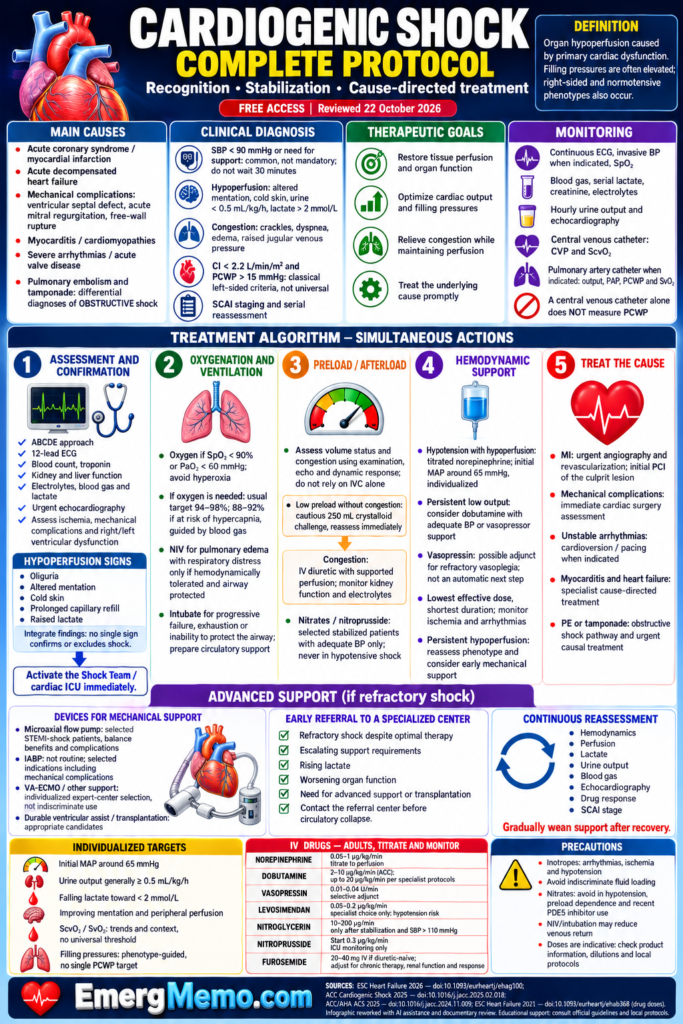
Complete cardiogenic shock protocol, reworked from the original and reviewed on 22 October 2026. Free access. Includes recognition, treatment algorithm, monitoring, drug doses, advanced support and precautions.
Open the image to view and zoom.
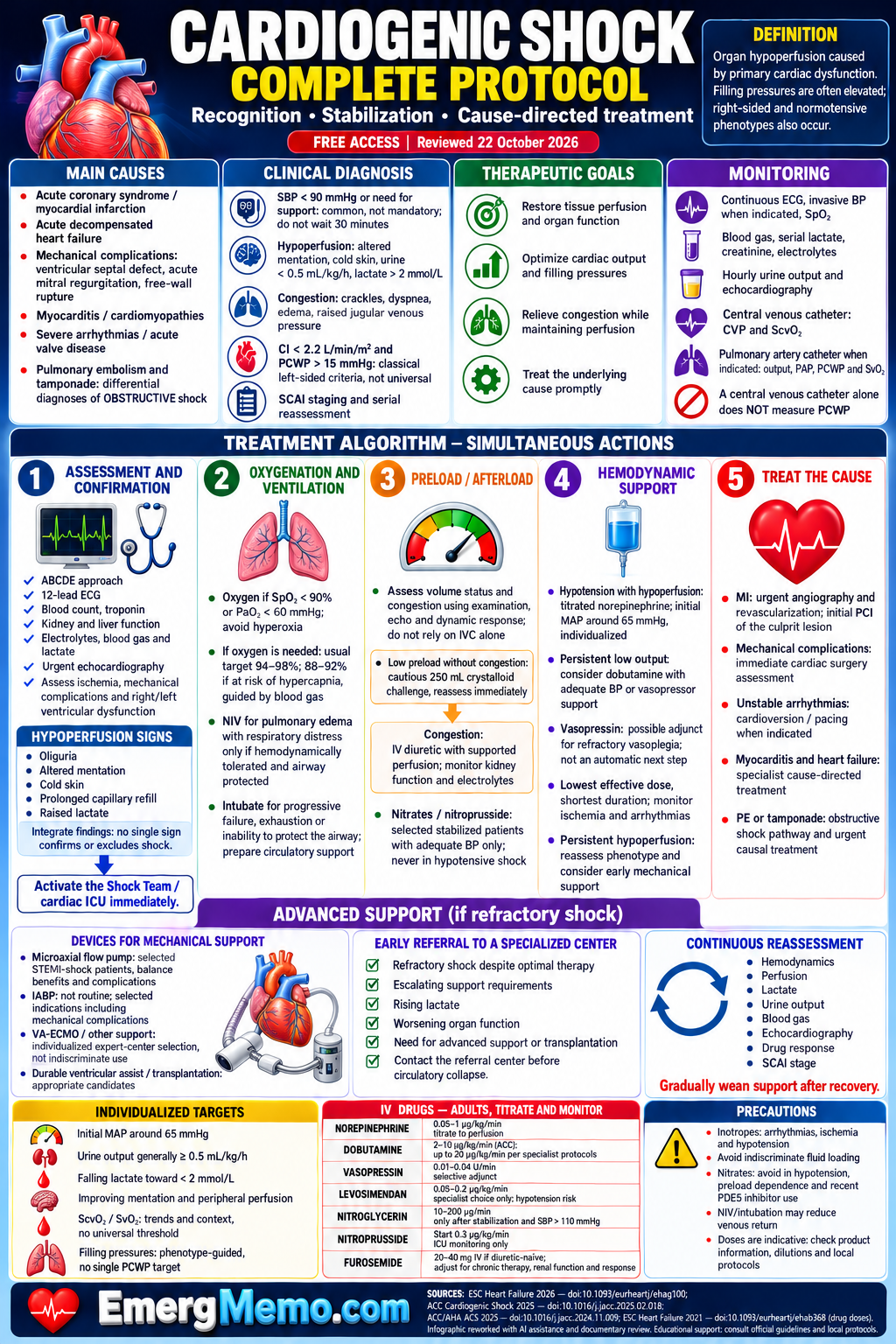
Complete readable text
CARDIOGENIC SHOCK — COMPLETE PROTOCOL
Recognition • Stabilization • Cause-directed treatment
FREE ACCESS | Reviewed 22 October 2026
DEFINITION:
Organ hypoperfusion caused by primary cardiac dysfunction. Filling pressures are often elevated; right-sided and normotensive phenotypes also occur.
MAIN CAUSES:
• Acute coronary syndrome / myocardial infarction
• Acute decompensated heart failure
• Mechanical complications: ventricular septal defect, acute mitral regurgitation, free-wall rupture
• Myocarditis / cardiomyopathies
• Severe arrhythmias / acute valve disease
• Pulmonary embolism and tamponade: differential diagnoses of OBSTRUCTIVE shock
CLINICAL DIAGNOSIS:
• SBP <90 mmHg or need for support: common, not mandatory; do not wait 30 minutes
• Hypoperfusion: altered mentation, cold skin, urine <0.5 mL/kg/h, lactate >2 mmol/L
• Congestion: crackles, dyspnea, edema, raised jugular venous pressure
• CI <2.2 L/min/m² and PCWP >15 mmHg: classical left-sided criteria, not universal
• SCAI staging and serial reassessment
THERAPEUTIC GOALS:
• Restore tissue perfusion and organ function
• Optimize cardiac output and filling pressures
• Relieve congestion while maintaining perfusion
• Treat the underlying cause promptly
MONITORING:
• Continuous ECG, invasive BP when indicated, SpO₂
• Blood gas, serial lactate, creatinine, electrolytes
• Hourly urine output and echocardiography
• Central venous catheter: CVP and ScvO₂
• Pulmonary artery catheter when indicated: output, PAP, PCWP and SvO₂
• A central venous catheter alone does NOT measure PCWP
TREATMENT ALGORITHM — simultaneous actions
1 ASSESSMENT AND CONFIRMATION:
ABCDE; 12-lead ECG; blood count, troponin, kidney/liver function, electrolytes, blood gas and lactate; urgent echocardiography. Assess ischemia, mechanical complications and right/left ventricular dysfunction.
HYPOPERFUSION SIGNS: oliguria, altered mentation, cold skin, prolonged capillary refill, raised lactate. Integrate findings: no single sign confirms or excludes shock. Activate the Shock Team / cardiac ICU immediately.
2 OXYGENATION AND VENTILATION:
• Oxygen if SpO₂ <90% or PaO₂ <60 mmHg; avoid hyperoxia
• If oxygen is needed: usual target 94–98%; 88–92% if at risk of hypercapnia, guided by blood gas
• NIV for pulmonary edema with respiratory distress only if hemodynamically tolerated and airway protected
• Intubate for progressive failure, exhaustion or inability to protect the airway; prepare circulatory support
3 PRELOAD / AFTERLOAD:
• Assess volume status and congestion using examination, echo and dynamic response; do not rely on IVC alone
• Low preload without congestion: cautious 250 mL crystalloid challenge, reassess immediately
• Congestion: IV diuretic with supported perfusion; monitor kidney function and electrolytes
• Nitrates / nitroprusside: selected stabilized patients with adequate BP only; never in hypotensive shock
4 HEMODYNAMIC SUPPORT:
• Hypotension with hypoperfusion: titrated norepinephrine; initial MAP around 65 mmHg, individualized
• Persistent low output: consider dobutamine with adequate BP or vasopressor support
• Vasopressin: possible adjunct for refractory vasoplegia; not an automatic next step
• Lowest effective dose, shortest duration; monitor ischemia and arrhythmias
• Persistent hypoperfusion: reassess phenotype and consider early mechanical support
5 TREAT THE CAUSE:
• MI: urgent angiography and revascularization; initial PCI of the culprit lesion
• Mechanical complications: immediate cardiac surgery assessment
• Unstable arrhythmias: cardioversion / pacing when indicated
• Myocarditis and heart failure: specialist cause-directed treatment
• PE or tamponade: obstructive shock pathway and urgent causal treatment
ADVANCED SUPPORT
DEVICES:
• Microaxial flow pump: selected STEMI-shock patients, balance benefits and complications
• IABP: not routine; selected indications including mechanical complications
• VA-ECMO / other support: individualized expert-center selection, not indiscriminate use
• Durable ventricular assist / transplantation: appropriate candidates
EARLY REFERRAL:
Refractory shock, escalating support, rising lactate, worsening organ function or need for advanced support. Contact the referral center before circulatory collapse.
CONTINUOUS REASSESSMENT:
Hemodynamics, perfusion, lactate, urine output, blood gas, echo, drug response and SCAI stage. Gradually wean support after recovery.
INDIVIDUALIZED TARGETS:
• Initial MAP around 65 mmHg
• Urine output generally ≥0.5 mL/kg/h
• Falling lactate toward <2 mmol/L
• Improving mentation and peripheral perfusion
• ScvO₂ / SvO₂: trends and context, no universal threshold
• Filling pressures: phenotype-guided, no single PCWP target
IV DRUGS — ADULTS, TITRATE AND MONITOR:
Norepinephrine: 0.05–1 µg/kg/min, titrate to perfusion
Dobutamine: 2–10 µg/kg/min (ACC); up to 20 per specialist protocols
Vasopressin: 0.01–0.04 U/min, selective adjunct
Levosimendan: 0.05–0.2 µg/kg/min, specialist choice only; hypotension risk
Nitroglycerin: 10–200 µg/min, only after stabilization and SBP >110 mmHg
Nitroprusside: start 0.3 µg/kg/min, ICU monitoring only
Furosemide: 20–40 mg IV if diuretic-naïve; adjust for chronic therapy, renal function and response
PRECAUTIONS:
• Inotropes: arrhythmias, ischemia and hypotension
• Avoid indiscriminate fluid loading
• Nitrates: avoid in hypotension, preload dependence and recent PDE5 inhibitor use
• NIV/intubation may reduce venous return
• Doses are indicative: check product information, dilutions and local protocols
Reviewed references
- ESC Heart Failure 2026
- ACC Cardiogenic Shock 2025
- ACC/AHA Acute Coronary Syndromes 2025
- ESC Heart Failure 2021 — drug doses
Infographic reworked with AI assistance and documentary review. Educational support for professionals: consult official guidelines, product information and local protocols.